
Short answer
To clean with no energy, shrink the plan before you start: pick the two or three jobs that stop the house getting worse, give each a short time limit, and let everything else wait without guilt. ADHD Cleaning Planner does this with an energy setting that resizes today's plan and keeps the rest as an optional bonus.
On this page
To clean with no energy, change the size of the plan instead of waiting for the energy to arrive. Pick the two or three jobs that stop the house getting worse, give each one a short time limit, and let everything else wait until a better day without counting it as a failure. A low energy cleaning plan is not a lazier version of a normal plan. It is a separate, smaller plan that you decide on in advance, so that on a bad day there is nothing left to work out.
Why do I have no energy to clean my house?
Having no energy to clean usually has more than one cause, and only some of them are about cleaning. The NHS lists not getting enough sleep, stress, depression and dealing with life challenges among the common causes of tiredness. A day at work, a bad night or a sick child takes from the same tank that cleaning needs.
With ADHD there is a second cost on top. The NHS names finding it hard to organise your time and finding it hard to finish tasks among the signs of ADHD in adults. Cleaning a room is mostly organising and finishing: deciding where to begin, what counts as done, and when to stop. So a job that looks like ten minutes of physical work can feel like an hour of thinking before you even stand up. That thinking is the part that runs out first on a low day.
Energy also changes from day to day. Maya, who has ADHD and whose cleaning tricks the app grew out of, says she sometimes gets a burst of energy and a taste for it, and sometimes has none at all. A plan built for the good days is too big for the others, and a plan built only for the bad days wastes the good ones.
Low energy that lasts is a different matter. The NHS advises seeing a GP if you have been feeling tired for a few weeks and are not sure why, or if tiredness affects your daily life. If you are coming out of a long stretch of exhaustion, read how to start cleaning again after ADHD burnout, and talk to a doctor or another professional: that is bigger than any cleaning method.
How to clean with low energy: a plan for bad days
A low energy cleaning plan works when it is decided on a better day and kept short enough to finish on a bad one. These steps work on paper as well as in an app:
- Write the bad-day list now, not on the bad day. Choose two or three jobs that stop the house getting worse: the dishes you will need tomorrow, rubbish that will smell, one clear surface to eat at. On a low day you only read the list.
- Put a time on each job. A job with a number of minutes next to it has an end. Maya sets a timer for 5, 10 or 15 minutes, does as much as she can, then stops or carries on if she feels like it. She says it does not always work, but it helps her begin very often.
- Make the first step physical. "Clean the kitchen" needs planning. "Put the mugs in the sink" does not.
- Keep the rest visible but optional. The other jobs are not cancelled. They wait in a list you may look at if you find a bit more energy, and may ignore if you do not.
- Let skipped jobs come back on their own. If a missed job is added to tomorrow, tomorrow gets bigger and harder. Better to let it come back the next time it is due.
- Keep an after-work version even smaller. If you have no energy to clean after work, plan for that evening on its own: one or two jobs with a time limit, such as ten minutes for the dishes you need tomorrow.
- Stop when the list is done. Finishing the small plan counts as a full day. Carrying on is a bonus, not the real target.
The room-by-room ADHD cleaning checklist is a free printable that is sized to your energy, if you would rather keep the bad-day list on paper. For how a week of small days fits together, see the ADHD cleaning routine that survives a bad week.
How ADHD Cleaning Planner resizes your plan to your energy
ADHD Cleaning Planner is the iPhone and Android app we make. It is free to download with in-app purchases and needs no account. Its energy setting does the steps above inside the app: you say how much energy you have, and the day's plan shrinks to fit. The words below are the app's own, and the screenshots are from the iPhone version.
1. Tell the app what most days look like
In the newer version of the setup, the app asks "How much energy do you usually have for cleaning?" The choices are Up to 15 minutes a day, Up to 35 minutes a day and I like to get stuff done. The line under the question says: "Pick what fits most days. You can change it anytime." That answer sets the size of an ordinary day in advance, so a bad day starts from a plan that is already small. If your setup did not ask, the Energy button on Today's Plan does the same.
2. Change it on the day: "How much energy?"
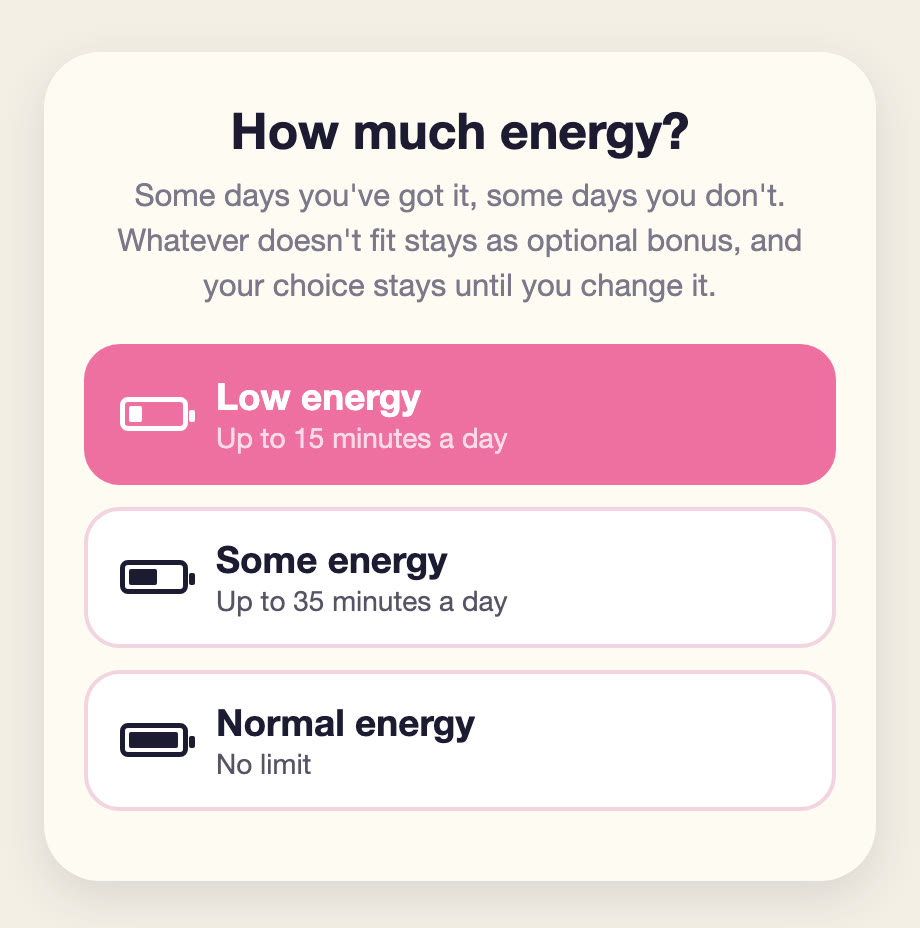
Each day you can change the energy setting. It asks "How much energy?" and offers Low energy, Some energy and Normal energy. The app explains what happens next: "Some days you've got it, some days you don't. Whatever doesn't fit stays as optional bonus, and your choice stays until you change it."
3. What does not fit moves to "If you can do more"
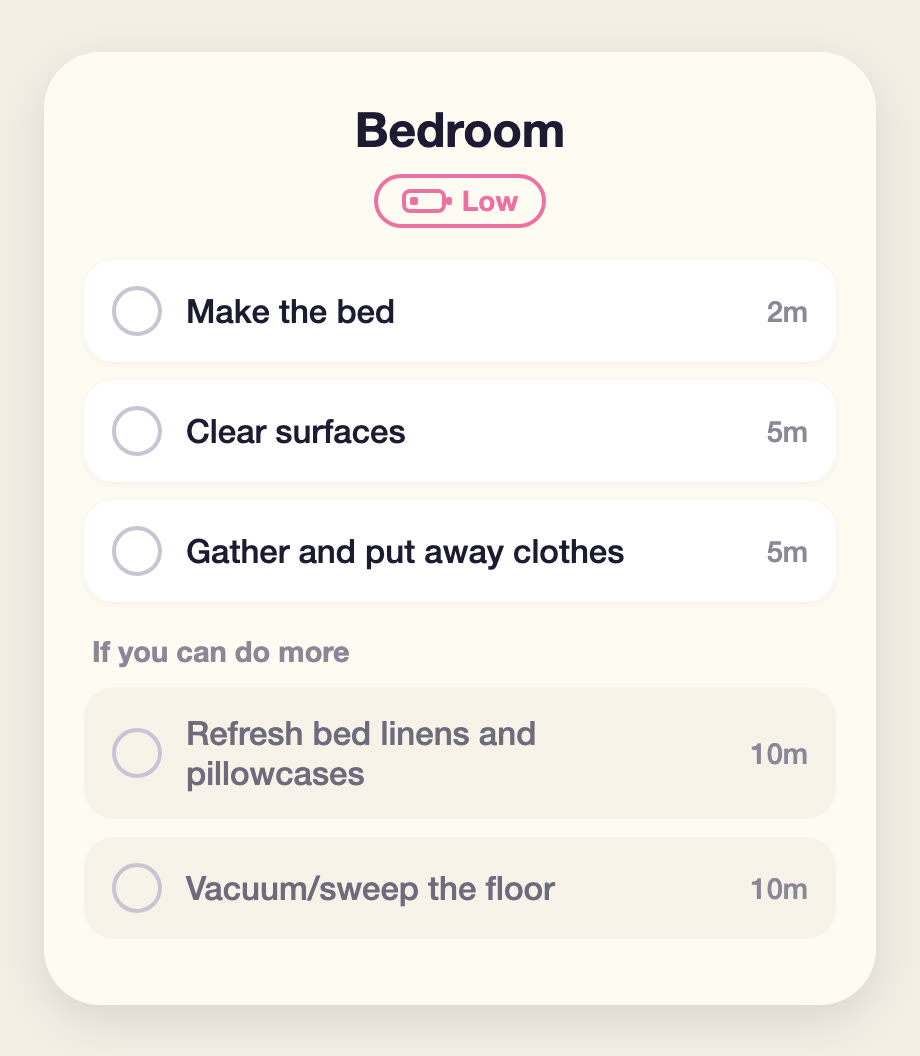
On a low energy day the tasks that do not fit are not deleted. They move into a section called If you can do more. On Today's Plan whole rooms move there; inside a room, the tasks that do not fit. The first room always stays in the plan, so there is always somewhere to start. When the smaller plan is finished, the app says "You're all done for today 🎉", and the bonus tasks are still there if you find some energy after all. Tasks show how many minutes they take, so you can see what a bonus task would cost before you start it.
A single task can also be dropped for the day with Not today. The app confirms: "Can't or don't want to do this one today? That's okay. It comes off today's list and comes back the next time it's due." And on the days you do have energy, a room that has nothing due says "Got energy to spare? Tick one off early."
4. When even the small plan is too much
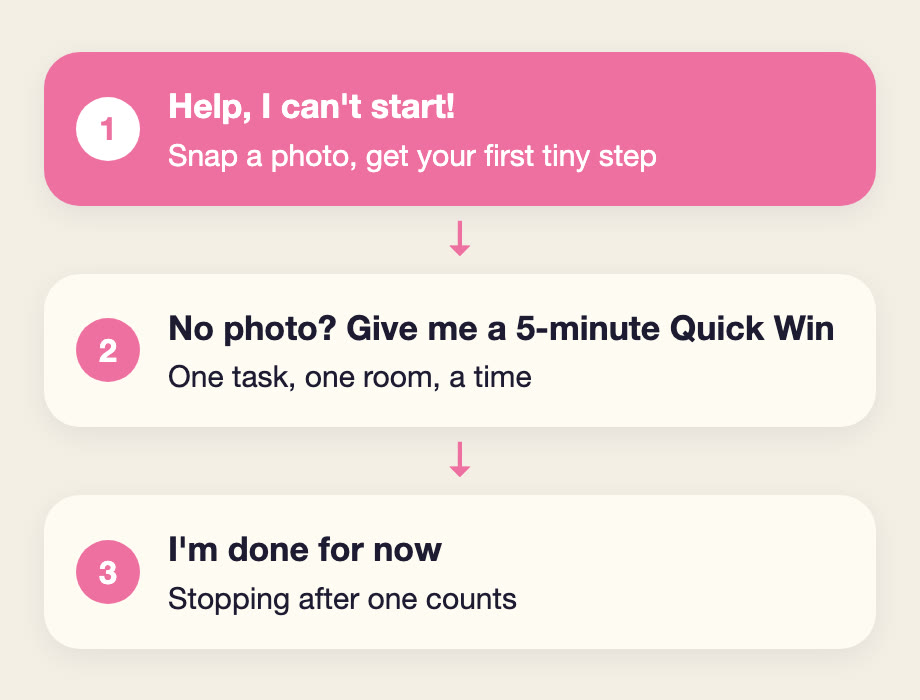
Some days the smallest plan still does not get you off the sofa. For those, Today's Plan has a "Help, I can't start!" button, with the line "Snap a photo, get your first tiny step". If a photo is too much as well, "No photo? Give me a 5-minute Quick Win" suggests one task in one room with an approximate time, and "Try another quick win" swaps it if it does not suit you. When it is done, you can tap "I'm done for now" and stop there.
What the energy setting does not do
The energy setting in ADHD Cleaning Planner does not know how you feel. You choose the setting yourself, and it stays where you left it until you change it. If you set it to Low energy and forget to set it back, the plan stays small on your good days too, and on a bad day you still have to remember to lower it.
ADHD Cleaning Planner plans for one person. There is no household, no shared list and no way to hand tasks to a partner or flatmate on a day you cannot do them, which is often the most useful thing on a low day.
ADHD Cleaning Planner is a newer app. Its App Store listing today shows 4.9 from 130 ratings, a small number next to apps that have been around for years. If you want to see it next to other options, we have compared cleaning apps for ADHD, ours included.
And the app is not treatment. An app can make the plan smaller; it cannot make you less tired. If low energy has lasted for weeks, a GP is a better first step than any cleaning plan.
A smaller plan is still a plan
Cleaning with no energy works when the plan fits the energy, not the other way round. Decide the bad-day version on a good day, put a time on every job, and let the rest wait without turning into debt. Paper can do that. ADHD Cleaning Planner does it with one setting, so on a low day you only have to say how much you have.
Frequently asked questions
Why do I have no energy to clean my house?
Common reasons are poor sleep, stress, a low mood and a lot going on in life, and with ADHD a cleaning job can also cost more effort than it looks because planning and finishing tasks are harder. If you have felt tired for weeks without knowing why, or it affects your daily life, the NHS advises seeing a GP.
What should I clean first when I have no energy?
Clean the things that make tomorrow harder if they wait: dishes you will need, rubbish that will smell, and one clear surface to eat or work at. Those few jobs stop the house getting worse. Everything else can move to a day with more energy.
How do I get the energy to clean my house?
Waiting for energy usually means waiting a long time. It works better to make the job small enough for the energy you have now: one task, a five to fifteen minute timer, and permission to stop when it rings. Starting often brings a bit of energy with it, but it does not have to.
What can I clean when I have no energy after work?
Use a short after-work list of one or two jobs with a time limit, such as ten minutes for the dishes you need tomorrow, and stop when the time is up. Decide that list in advance and keep it smaller than the plan for a day off.
How does the energy setting in ADHD Cleaning Planner work?
You choose Low energy, Some energy or Normal energy, and today's plan resizes to fit. Tasks that do not fit stay as an optional bonus under If you can do more, and your choice stays until you change it. Nothing is deleted, and skipped tasks come back the next time they are due.