
Short answer
About 6% of US adults, roughly 15.5 million people, have a current ADHD diagnosis, and more than half were diagnosed as adults. ADHD is closely linked to clutter: in a UK clinic study, about 1 in 5 adults with ADHD had clinically significant hoarding symptoms, against 2% of people without ADHD. Inattention, not hyperactivity, drives the link.
On this page
If you have ADHD and your home keeps slipping away from you, you are in large company, and the research has a fair amount to say about why. This page brings together what studies and government data show about ADHD and the home: how common ADHD is, which traits make cleaning hard, and how that shows up as clutter, unfinished chores and tension with the people you live with. Every number links to its source at the bottom of the page.
ADHD and the home at a glance
ADHD and the home in six numbers
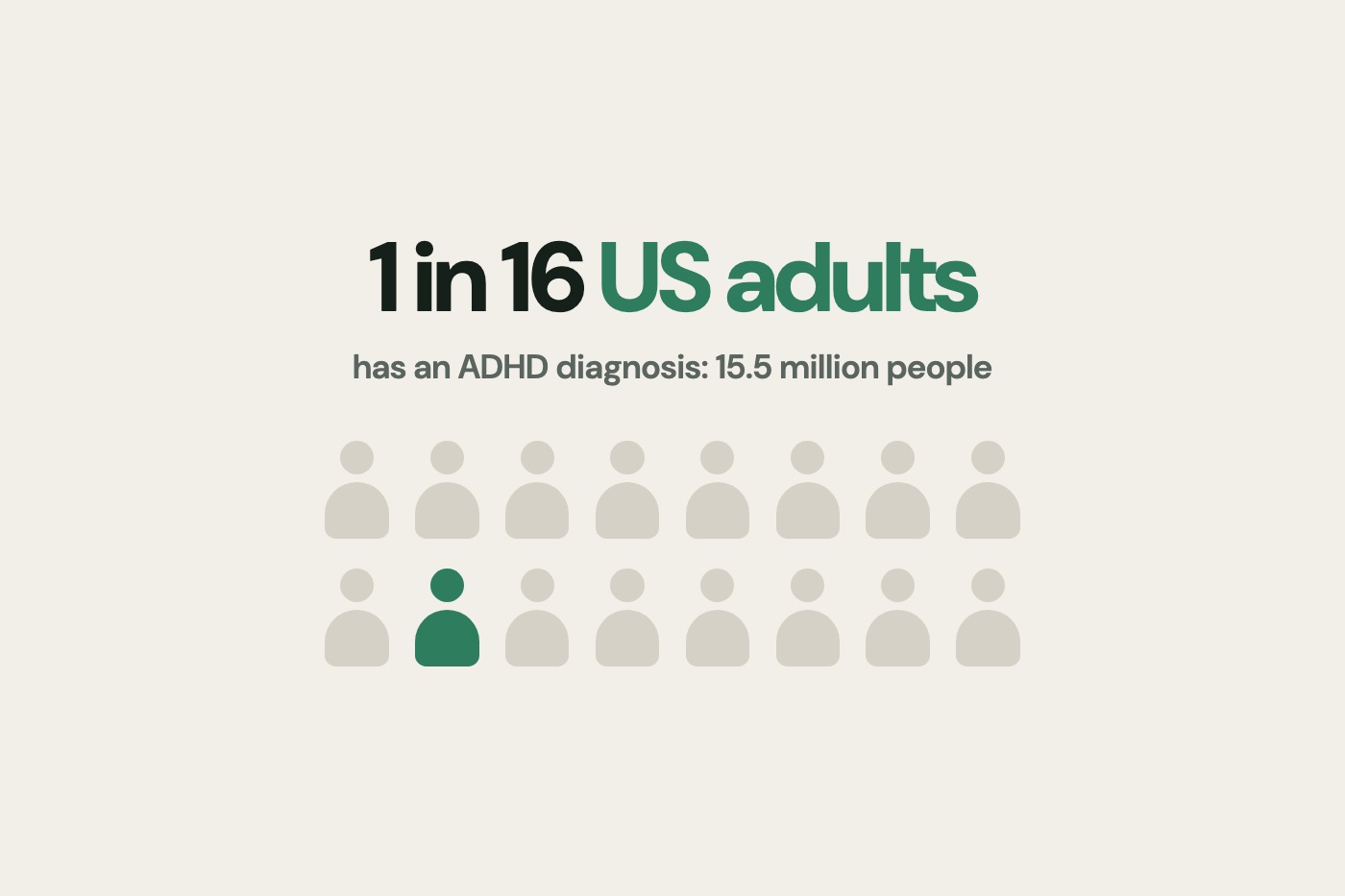
1 in 16 US adults
has an ADHD diagnosis: about 15.5 million people.[1]
56% diagnosed late
of US adults with ADHD were 18 or older when they were diagnosed.[1]
19% vs 2%
of adults with and without ADHD had hoarding symptoms in a UK clinic study.[11]
6 in 10 adults with ADHD
screen positive for a sleep disorder, in a Dutch clinic study of 3,691 adults.[9]
<1 in 3 children
with ADHD often do their chores well and on their own, according to 797 US parents.[18]
49 vs 18 minutes
of housework a day for the average US woman and man in 2025.[23]
Sources are numbered and listed at the end of this article.
How common is ADHD in the US?
About 1 in 16 US adults has a current ADHD diagnosis. A CDC survey of 7,046 adults in October and November 2023 put it at 6.0%, or roughly 15.5 million people.[1] Among children aged 3 to 17, 11.4% had ever been diagnosed and 10.5% had ADHD at the time of the 2022 survey.[2]
For many adults the diagnosis came late. More than half of the adults in the CDC survey were diagnosed at 18 or older, and about a third were not getting any treatment at all.
Share of US adults with a current ADHD diagnosis. The last bar only covers adults taking stimulant medication, who reported shortages in the previous 12 months. Source: CDC, MMWR 2024.[1]
Diagnoses are rising too. In one large US health system, the share of adults with an ADHD diagnosis more than doubled in ten years, from 0.43% in 2007 to 0.96% in 2016.[4] Women in particular tend to be diagnosed later than men: in a Spanish study of 900 adults with ADHD, women received their diagnosis significantly later, even though their symptoms had started at the same age.[5] Worldwide, an estimated 2.6% of adults have ADHD that began in childhood and carried on.[3]
A late diagnosis often means years of believing a messy home was a matter of character. The research on how ADHD works suggests something else.
Why is cleaning harder with ADHD?
Cleaning leans on exactly the skills ADHD makes unreliable: starting a boring task, keeping a plan in mind, judging how long something will take and staying with it until it is done. That is why so many people describe not being able to start cleaning at all, even when they badly want a clean home. The research on each of those skills points the same way.
| What makes it hard | What studies found |
|---|---|
| Planning and working memory | Groups with ADHD scored lower on every executive-function measure across 83 studies, most clearly on inhibition, vigilance, working memory and planning.[6] |
| Sense of time | Children and teens with ADHD judge time less accurately and less consistently than their peers, across 27 studies.[7] |
| Putting things off | Procrastination was consistently linked to ADHD symptoms in 11 studies with 2,788 people, most strongly to inattention.[8] |
| Boredom | Boredom proneness correlates with ADHD at r = 0.40, across 18 studies and 22,365 people.[10] |
| Tiredness | About 60% of 3,691 adults at a Dutch ADHD clinic screened positive for a sleep disorder, 36% for a delayed sleep rhythm.[9] |
| Overwhelm | Adults with ADHD show much stronger emotion dysregulation than adults without it, and it grows with symptom severity.[12] |
Put together, these explain a familiar evening. A pile of dishes feels like an hour of work, so it waits; boredom makes it easy to drift off halfway; and by the time there is energy for it, the pile has doubled. Over weeks and months, the same pattern leaves its mark on the home itself, most visibly as clutter.
ADHD, clutter and hoarding
This is the strongest finding in the research on ADHD and the home. Adults with ADHD have far higher rates of hoarding symptoms than people without it, and the link runs through inattention. In a 2022 UK study, 19.3% of adults at an ADHD clinic had clinically significant hoarding symptoms, against 2.2% of matched controls.[11] Inattention was the only ADHD trait that predicted how severe the hoarding was; hyperactivity and impulsivity did not. Two other studies, in Italy and across nine European countries, found the same gap.
UK, adult ADHD clinic, 2022
Italy, adult clinic, 2023
Nine European countries, general population, 2013
UK and Italy: share above the threshold for clinically significant hoarding on a self-report questionnaire. Europe: lifetime hoarding symptoms among 2,963 adults from the WHO World Mental Health Surveys. Sources: Morein-Zamir et al. 2022, Grassi et al. 2023, Fullana et al. 2013.[11] [13] [15]
To put those numbers in perspective: hoarding disorder affects about 2.5% of adults in the general population, at similar rates in men and women.[16] And the link works in both directions. Among 217 people in the US with hoarding disorder, 28% met the criteria for inattentive ADHD, against 3% of people with OCD.[14] In the European study, adults who had been inattentive as children were about six times as likely to report hoarding later in life.[15]
Two findings are worth holding on to. First, the UK researchers noted that adults with ADHD rarely bring clutter up with their doctor, so it often goes unnoticed.[11] Second, it can change: after at least a year on methylphenidate, 71.6% of 60 newly diagnosed adults in Italy had fewer hoarding symptoms. Clutter and buying improved, though throwing things away stayed hard, and the study had no control group.[17] Clutter also runs in families: in a UK study of twins, children with a higher genetic risk for ADHD, and their mothers, lived in more chaotic homes.[20]
Most people with ADHD will never meet the criteria for hoarding. For them, the everyday version is the pile of undecided things on a chair or a counter, often called a doom pile. The mechanism is the same one: every item needs a small decision, and inattention makes that decision easy to put off. Clutter is, in a sense, what is left behind when chores don't get finished, which brings us to the chores themselves.
ADHD and household chores
The clearest data on chores comes from parents. In a survey of 797 US caregivers of children aged 6 to 18 with ADHD, fewer than a third said their child often or very often did chores satisfactorily or on their own.[18] Almost all of them saw ADHD as the reason, and most said their child needed more reminders than other children.
Share of 797 US caregivers of children with ADHD. Self-care chores are things like making the bed; family chores are things like setting the table. Source: Spaulding et al., Journal of Attention Disorders.[18]
A follow-up study of 565 parents found that children whose medication still worked after school met their parents' expectations more often on 5 of 8 chores, but they did not need fewer reminders.[19] That is a useful way to see reminders: not as a sign that something failed, but as part of how chores get done with ADHD. It is the thinking behind a written cleaning checklist, where the list does the remembering.
For adults, there is much less data. No study has yet measured how much time adults with ADHD spend on housework, or how they share it with a partner. What has been studied is what happens between partners when the housework doesn't get done.
ADHD, relationships and divorce
Housework comes up again and again in research on ADHD and relationships. In a study of 80 couples where one partner had ADHD, "leaves a mess" and "doesn't finish household projects" were both among the ten behaviours that most made the other partner feel unloved or ignored, and the partners with ADHD agreed.[21]
The divorce figures are real, but narrower than they are often quoted. One study compared adults with and without an ADHD diagnosis; the other followed parents of children with ADHD, and there the gap had closed by the time the children were older.
Adults ever divorced, 2006
Parents divorced by the time their child was 8, 2008
2006: 500 US adults who reported an ADHD diagnosis and 501 matched adults. 2008: 282 families of children with ADHD and 206 without; after age 8 the difference was no longer significant. Sources: Biederman et al. 2006, Wymbs et al. 2008.[22] [24]
Neither study shows that housework causes divorce. They do show that in homes with ADHD, the everyday load weighs more, which is worth knowing when you look at how big that load is for everyone.
How much time does housework take?
On an average day in 2025, 36.1% of Americans aged 15 and over did some housework. Women were twice as likely to as men, at 47.9% against 23.8%, and spent more time on it.[23]
Average across everyone
Among people who did housework that day
Housework includes interior cleaning, laundry and household management. Converted from hours per day (0.81, 0.30, 1.69 and 1.25). Source: US Bureau of Labor Statistics, American Time Use Survey 2025.[23]
Clutter makes that load feel heavier. In a well-known UCLA study of 30 couples, wives who described their homes with more words about clutter and unfinished projects had flatter daily cortisol curves and a mood that sank over the day; husbands did not show the pattern.[25] And when 363 US students were asked why their belongings were disorganised, the top answers were lack of time (37%), procrastination (34%) and being easily distracted (26%): the same difficulties that ADHD turns up.[26]
What these numbers mean for your home
Read together, the research points to a few practical things. None of them depends on more willpower.
- Make jobs small and time them. A sense of time that overestimates chores makes them hard to start. A job with a clear end, like ten minutes or one surface, is easier to begin than "clean the kitchen".
- Let a list do the remembering. Even with medication, children with ADHD still needed reminders. Adults are no different, so reminders are a tool, not a failure.
- Deal with decisions, not just mess. Clutter with ADHD is driven by inattention: things pile up where a decision was put off. Sorting first and deciding later clears piles faster.
- Mention clutter to your doctor. It is common with ADHD, rarely raised, and in one study improved with treatment.
If you want a place to start, a weekly cleaning schedule built for ADHD splits the house into small, timed jobs spread over the week.
Sources
- Staley BS, et al. Attention-Deficit/Hyperactivity Disorder Diagnosis, Treatment, and Telehealth Use in Adults. MMWR 2024;73(40). CDC, MMWR report
- Danielson ML, Claussen AH, Bitsko RH, et al. ADHD Prevalence Among U.S. Children and Adolescents in 2022: Diagnosis, Severity, Co-Occurring Disorders, and Treatment. J Clin Child Adolesc Psychol 2024;53(3):343-360. doi:10.1080/15374416.2024.2335625
- Song P, Zha M, Yang Q, et al. The prevalence of adult attention-deficit hyperactivity disorder: A global systematic review and meta-analysis. J Glob Health 2021;11:04009. doi:10.7189/jogh.11.04009
- Chung W, Jiang S, Paksarian D, et al. Trends in the Prevalence and Incidence of Attention-Deficit/Hyperactivity Disorder Among Adults and Children of Different Racial and Ethnic Groups. JAMA Netw Open 2019;2(11):e1914344. doi:10.1001/jamanetworkopen.2019.14344
- Mestres F, Richarte V, Crespín JJ, et al. Sex differences in adults with attention-deficit/hyperactivity disorder: A population-based study. Eur Psychiatry 2025;68(1). doi:10.1192/j.eurpsy.2025.2441
- Willcutt EG, Doyle AE, Nigg JT, et al. Validity of the Executive Function Theory of Attention-Deficit/Hyperactivity Disorder: A Meta-Analytic Review. Biol Psychiatry 2005;57(11):1336-1346. doi:10.1016/j.biopsych.2005.02.006
- Zheng Q, Wang X, Chiu KY, et al. Time Perception Deficits in Children and Adolescents with ADHD: A Meta-analysis. J Atten Disord 2022;26(2):267-281. doi:10.1177/1087054720978557
- Suriano R. A systematic review on the association between ADHD and procrastination. Res Dev Disabil 2026;175:105342. doi:10.1016/j.ridd.2026.105342
- van der Ham M, Bijlenga D, Böhmer M, et al. Sleep Problems in Adults With ADHD: Prevalences and Their Relationship With Psychiatric Comorbidity. J Atten Disord 2024;28(13):1642-1652. doi:10.1177/10870547241284477
- Muris P, Otgaar H, Donkers F. The Boredom-ADHD Nexus: A Narrative and Meta-Analytic Review of the Evidence. Clin Child Fam Psychol Rev 2026;29(3):432-451. doi:10.1007/s10567-026-00563-9
- Morein-Zamir S, Kasese M, Chamberlain SR, Trachtenberg E. Elevated levels of hoarding in ADHD: a special link with inattention. J Psychiatr Res 2022;145:167-174. Full text on Europe PMC
- Beheshti A, Chavanon M, Christiansen H. Emotion dysregulation in adults with attention deficit hyperactivity disorder: a meta-analysis. BMC Psychiatry 2020;20:120. doi:10.1186/s12888-020-2442-7
- Grassi G, Moradei C, Cecchelli C, et al. Who really hoards? Hoarding symptoms in adults with attention-deficit hyperactivity disorder (ADHD), obsessive-compulsive disorder (OCD) and healthy controls. J Psychiatr Res 2023;166:74-79. doi:10.1016/j.jpsychires.2023.09.006
- Frost RO, Steketee G, Tolin DF. Comorbidity in hoarding disorder. Depress Anxiety 2011;28(10):876-884. doi:10.1002/da.20861
- Fullana MA, Vilagut G, Mataix-Cols D, et al. Is ADHD in childhood associated with lifetime hoarding symptoms? An epidemiological study. Depress Anxiety 2013;30(8):741-748. doi:10.1002/da.22123
- Postlethwaite A, Kellett S, Mataix-Cols D. Prevalence of Hoarding Disorder: A systematic review and meta-analysis. J Affect Disord 2019;256:309-316. doi:10.1016/j.jad.2019.06.004
- Grassi G, Scillitani E, Moradei C, et al. Long-term changes of hoarding symptoms among adults with attention-deficit/hyperactivity disorder (ADHD) treated with methylphenidate. J Psychiatr Res 2025;190:102-111. doi:10.1016/j.jpsychires.2025.07.031
- Spaulding SL, Fruitman K, Rapoport E, Soled D, Adesman A. Impact of ADHD on Household Chores. J Atten Disord 2021;25(10):1374-1383. doi:10.1177/1087054720903359
- Park F, Rapoport E, Soled D, et al. Impact of Medication on Performance of Household Chores by Children with ADHD. J Atten Disord 2022;26(1):119-124. doi:10.1177/1087054720969980
- Agnew-Blais JC, Wertz J, Arseneault L, et al. Mother's and children's ADHD genetic risk, household chaos and children's ADHD symptoms: A gene-environment correlation study. J Child Psychol Psychiatry 2022;63(10):1153-1163. doi:10.1111/jcpp.13659
- Robin AL, Payson E. The Impact of ADHD on Marriage. The ADHD Report 2002;10(3):9-14. A pilot study, not a peer-reviewed journal article.
- Biederman J, Faraone SV, Spencer TJ, et al. Functional Impairments in Adults With Self-Reports of Diagnosed ADHD. J Clin Psychiatry 2006;67(4):524-540. doi:10.4088/jcp.v67n0403
- US Bureau of Labor Statistics. American Time Use Survey, 2025 results, Table 1. BLS, ATUS Table 1
- Wymbs BT, Pelham WE, Molina BSG, et al. Rate and predictors of divorce among parents of youths with ADHD. J Consult Clin Psychol 2008;76(5):735-744. doi:10.1037/a0012719
- Saxbe DE, Repetti R. No Place Like Home: Home Tours Correlate With Daily Patterns of Mood and Cortisol. Pers Soc Psychol Bull 2010;36(1):71-81. doi:10.1177/0146167209352864
- Dozier ME, Chabaud S, Krafft J, et al. Psychosocial impact of hoarding symptoms in college students and the potential for early intervention. J Am Coll Health 2025;73(8):3290-3296. doi:10.1080/07448481.2024.2400566
Frequently asked questions
What percentage of people with ADHD have hoarding problems?
Studies of adults at ADHD clinics put it between about 1 in 5 and 1 in 3. A 2022 UK study found clinically significant hoarding symptoms in 19% of adults with ADHD against 2% of matched controls, and a 2023 Italian study found 32% against 4%. These are symptoms on a questionnaire, not diagnoses of hoarding disorder.
Do people with ADHD have messier homes?
The research points that way, but nobody has measured ordinary mess directly. What has been measured is hoarding symptoms, which include clutter, and household chaos. Both are higher with ADHD, and in several studies inattention was the trait that predicted clutter, not hyperactivity.
What is the divorce rate for people with ADHD?
There is no national divorce rate for adults with ADHD. The most cited study, from 2006, found that 28% of US adults who reported an ADHD diagnosis had ever been divorced, against 15% of matched adults without one. The often quoted claim that ADHD couples are twice as likely to divorce comes from research on parents of children with ADHD.
How many adults in the US have ADHD?
About 15.5 million, or 6.0% of US adults, had a current ADHD diagnosis in a CDC survey from late 2023. More than half of them, 55.9%, were diagnosed at 18 or older, and about a third were not receiving any treatment.